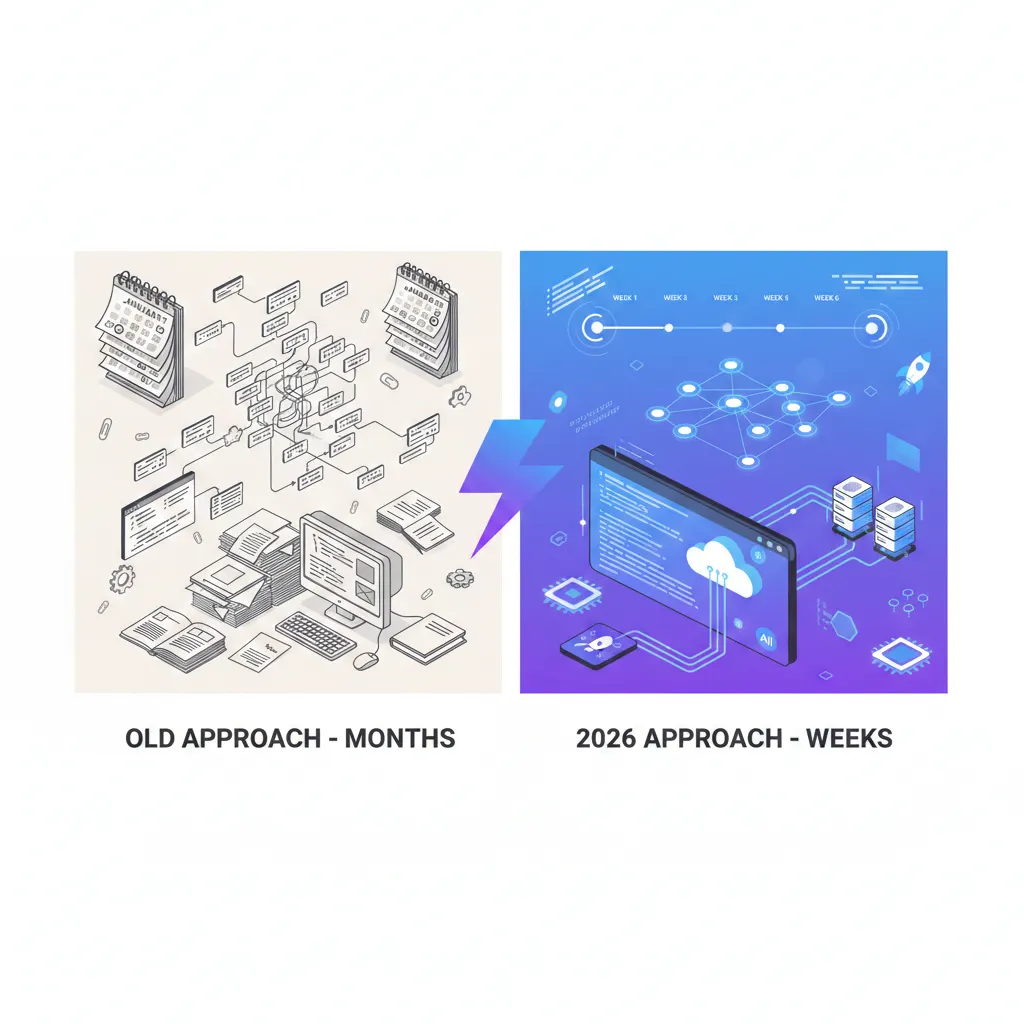
Building a successful startup MVP is just the beginning. As user demands grow and competition intensifies, AI application development services have become essential for startups looking to scale efficiently. Intelligent automation transforms basic MVPs into robust, scalable applications that adapt to market needs while reducing operational costs and accelerating time-to-market.
Startups that integrate AI early gain a competitive edge—automating workflows, personalizing user experiences, and making data-driven decisions faster than traditional development approaches allow.
Key Takeaways
- AI application development services enable startups to transform MVPs into intelligent, scalable solutions that adapt to user behavior and market demands
- Intelligent automation reduces manual processes by up to 60%, allowing lean teams to focus on strategic growth rather than repetitive tasks
- Partnering with specialized AI development companies provides access to cutting-edge technologies like machine learning, natural language processing, and predictive analytics without building in-house expertise
Why Startups Need AI Application Development Services
Traditional MVP development focuses on validating core features, but scaling requires sophisticated capabilities that manual processes can’t sustain. AI application development services bridge this gap by embedding intelligence directly into your product architecture.
Modern startups face intense pressure to deliver personalized experiences, process vast amounts of data, and respond to market changes in real-time. An AI automation agency for startups understands these unique challenges and provides tailored solutions that grow with your business. According to recent industry data, startups leveraging AI see 40% faster product iterations and 35% higher customer retention rates compared to those relying solely on traditional development methods.
The right AI development partner doesn’t just build features—they architect systems that learn, adapt, and improve autonomously. This includes intelligent recommendation engines, automated customer support, predictive analytics for business intelligence, and self-optimizing workflows that reduce technical debt as you scale.
Core Components of Intelligent Automation for MVPs
Automated Data Processing and Analysis: Intelligent automation starts with data. AI-powered systems collect, clean, and analyze user behavior data in real-time, uncovering patterns that manual analysis would miss. This enables startups to make evidence-based product decisions faster.
Your MVP generates valuable signals from every user interaction—clicks, session duration, feature usage, and drop-off points. AI development solutions transform this raw data into actionable insights, automatically identifying which features drive engagement and which create friction. Machine learning models continuously refine these insights as your user base grows, ensuring recommendations remain relevant and accurate.
Modern data pipelines integrate seamlessly with existing tech stacks, processing thousands of events per second while maintaining data integrity and compliance. Startups using automated data analysis reduce decision-making time from weeks to hours, accelerating their product-market fit journey significantly.
Building Scalable Architecture with Agentic Systems
Autonomous Decision-Making Capabilities: As your startup scales, manual oversight becomes a bottleneck. Agentic systems represent the next evolution in AI—autonomous agents that make decisions, execute tasks, and optimize processes without constant human intervention.
Agentic systems development creates intelligent agents that handle everything from customer onboarding to inventory management. These systems don’t just follow rules—they learn from outcomes and adapt strategies based on performance metrics. For example, an agentic customer support system routes inquiries based on complexity, sentiment, and historical resolution patterns, ensuring optimal resource allocation.
The architecture supports multiple specialized agents working in coordination—one optimizing pricing strategies, another managing deployment pipelines, and a third monitoring system health. This distributed intelligence scales effortlessly as operations grow, maintaining consistency and reliability without proportional increases in operational overhead. Startups implementing agentic systems report 50% reductions in operational costs within the first year.
Integration Strategies for Existing MVP Infrastructure
Seamless Technology Stack Enhancement: Many startups worry that adding AI means rebuilding from scratch. Strategic AI application development services focus on incremental integration that enhances existing systems rather than replacing them.
The integration process begins with identifying high-impact areas where automation delivers immediate value—typically customer-facing features, data processing workflows, or resource allocation systems. Modern AI frameworks offer flexible APIs and microservices architectures that plug into existing codebases with minimal disruption.
Cloud-native AI services from providers like AWS, Google Cloud, and Azure enable startups to leverage pre-trained models and scalable infrastructure without massive upfront investments. Working with experienced AI software development companies ensures smooth integration, proper testing protocols, and fallback mechanisms that protect user experience during deployment. The phased approach allows startups to validate ROI at each stage before expanding AI capabilities further.
Measuring Success and Optimizing Performance
Continuous Improvement Through AI Analytics: Implementing AI is not a one-time project—it requires ongoing measurement and optimization. Successful startups establish clear KPIs that align AI capabilities with business objectives before deployment begins.
Key metrics include automation efficiency rates, prediction accuracy scores, user engagement improvements, and cost reduction percentages. AI systems generate extensive telemetry data that reveals optimization opportunities humans might overlook. Automated A/B testing frameworks continuously experiment with different algorithms and parameters, identifying the highest-performing configurations without manual intervention.
Advanced monitoring dashboards provide real-time visibility into system performance, alerting teams to anomalies before they impact users. Machine learning models that power these systems benefit from feedback loops—every interaction improves future predictions. Startups should plan for quarterly AI performance reviews, assessing whether current capabilities still align with evolving business needs and market conditions.
Choosing the Right AI Development Partner
Evaluating Expertise and Cultural Fit: Not all AI development providers offer the same value. Startups should evaluate potential partners based on technical expertise, startup-specific experience, and cultural alignment with your team’s working style.
Look for partners with proven experience in your industry vertical who understand the unique constraints startups face—limited budgets, tight timelines, and rapidly changing requirements. The best AI automation agencies for startups offer flexible engagement models that adapt as your needs evolve, from initial MVP enhancement through enterprise-scale operations.
Technical capabilities matter, but communication and collaboration styles matter equally. Your AI development partner should explain complex concepts clearly, involve your team in architectural decisions, and transfer knowledge throughout the engagement. Request case studies demonstrating measurable business outcomes, not just technical implementations. Ask about their approach to data privacy, security compliance, and ethical AI practices—these considerations become critical as your startup scales.
Conclusion
AI application development services are no longer a luxury for well-funded enterprises—they’re essential for startups competing in today’s fast-paced digital landscape. By embedding intelligent automation into your MVP, you create products that scale efficiently, deliver personalized experiences, and adapt to market changes autonomously.
The key to successful AI integration lies in strategic planning, choosing the right development partner, and maintaining focus on business outcomes rather than technology for its own sake. Startups that approach AI product engineering with clear objectives and realistic expectations position themselves for sustainable growth and market leadership.
Ready to transform your MVP with intelligent automation? Partner with experts who understand both the technical challenges and business realities of scaling a startup. Contact Zackriya Solutions to explore how AI can accelerate your growth journey.
AI application development services involve creating intelligent software solutions that use machine learning, natural language processing, and automation to enhance business operations. These services help startups build scalable applications that learn from data, automate repetitive tasks, and deliver personalized user experiences without requiring extensive in-house AI expertise.
AI integration costs vary based on complexity and scope, typically ranging from $15,000 to $100,000 for startup MVPs. Factors include data infrastructure requirements, model complexity, integration depth, and ongoing maintenance needs. Cloud-based AI solutions offer flexible pricing models that scale with usage, making AI accessible for early-stage startups.
AI integration timelines range from 4 to 12 weeks depending on project scope and existing infrastructure. Simple implementations like chatbots or recommendation engines may take 4-6 weeks, while complex agentic systems requiring custom model training can extend to 3-4 months. Phased approaches allow startups to see results incrementally.
No, partnering with experienced AI software development companies eliminates the need for an in-house data science team. These partners provide end-to-end services including data architecture, model development, deployment, and maintenance. This approach is more cost-effective for early-stage startups than building internal AI capabilities.
Key AI types include predictive analytics for forecasting user behavior, natural language processing for customer support automation, computer vision for image-based features, and recommendation systems for personalization. Agentic systems development creates autonomous agents that handle complex workflows, reducing manual intervention and operational costs significantly.
Measure AI ROI through metrics like automation efficiency rates (hours saved), customer engagement improvements (retention, conversion rates), cost reduction percentages, and revenue growth attributed to AI features. Track baseline metrics before implementation and compare quarterly. Most startups working with AI consulting services see positive ROI within 6-12 months of deployment.
Yes, when implemented properly. Enterprise-grade AI development solutions include encryption, access controls, compliance frameworks (GDPR, SOC 2), and secure data handling practices. Choose development partners with proven security track records and ensure data processing agreements protect your intellectual property and customer information throughout the engagement.
Absolutely. Intelligent automation handles tasks like customer support, data analysis, content moderation, and workflow optimization that would otherwise require additional headcount. Startups using AI automation report handling 3-5x more customer interactions with the same team size, enabling growth without proportional increases in operational costs.
Traditional automation follows fixed rules and workflows, while AI automation learns from data and adapts to changing conditions. AI systems improve performance over time, handle exceptions intelligently, and make predictions about future needs. This adaptive capability makes AI automation significantly more powerful for complex, evolving startup environments.
Evaluate partners based on startup-specific experience, technical expertise in your industry, cultural fit, and transparent pricing models. Request case studies with measurable business outcomes, assess their communication style during discovery, and verify their approach to knowledge transfer. The best AI agent development services offer flexible engagements that evolve with your needs.